


On the Way Home
I find some sort of magic with each click, click, click of the shutter which keeps me optimistic and persistent in this practice.
During semester breaks I have a bit more time to focus my attention on taking photographs. My creative juices shift from attempting to devise interesting ways to teach stative verbs and gerunds to attempting to frame the world in all its unfamiliarity. Once the semester starts, however, my photography slowly starts to fade, collecting digital dust on 2TB hard drives and Lord-only-knows which server farm that hosts my Lightroom files. My website and other creative projects, such as music making take a back seat as I focus on my teaching, mostly only snapping shots on the weekends, which recently has turned into quite The Weekend Report with my good friend David Goeb.
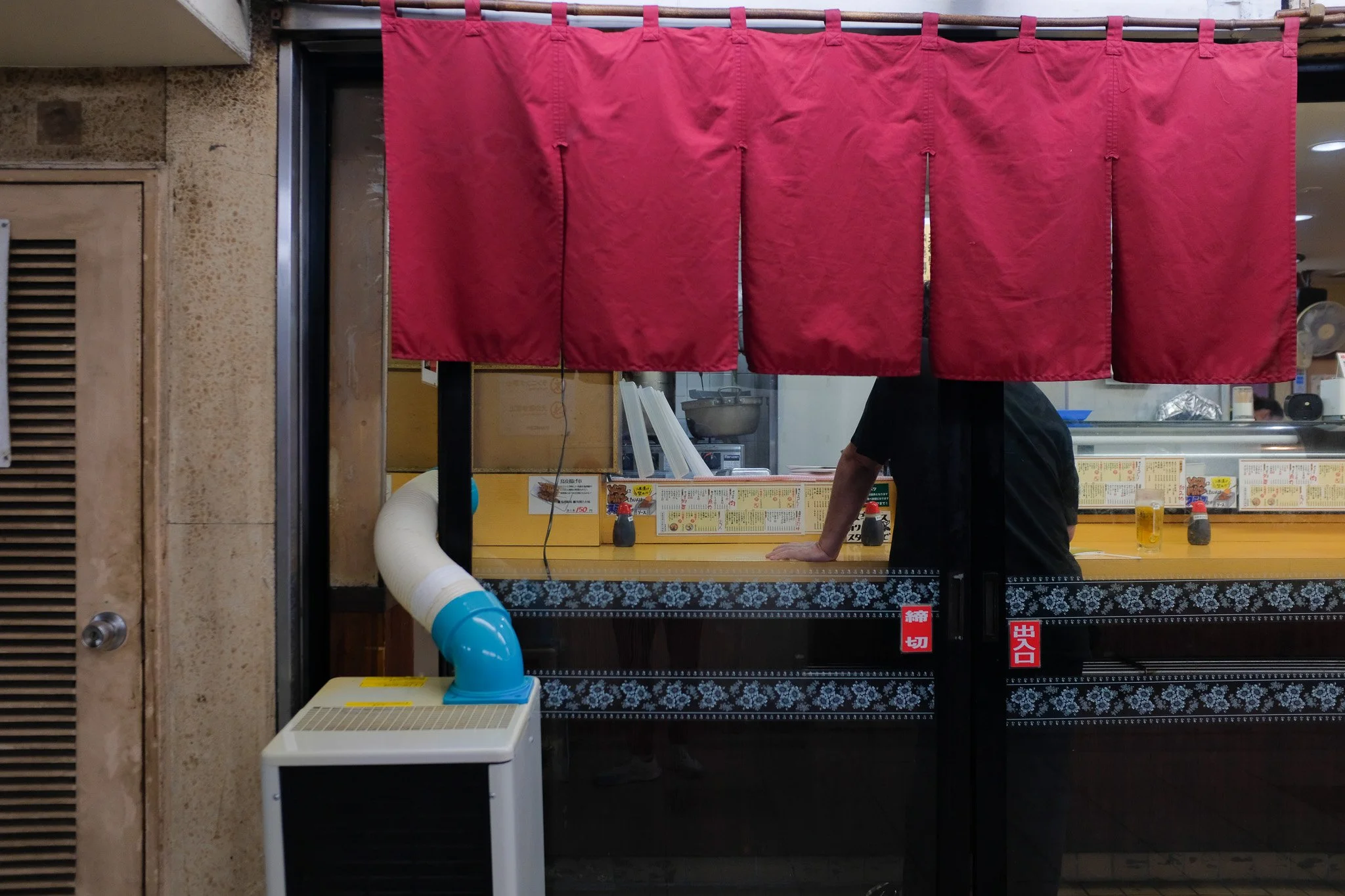
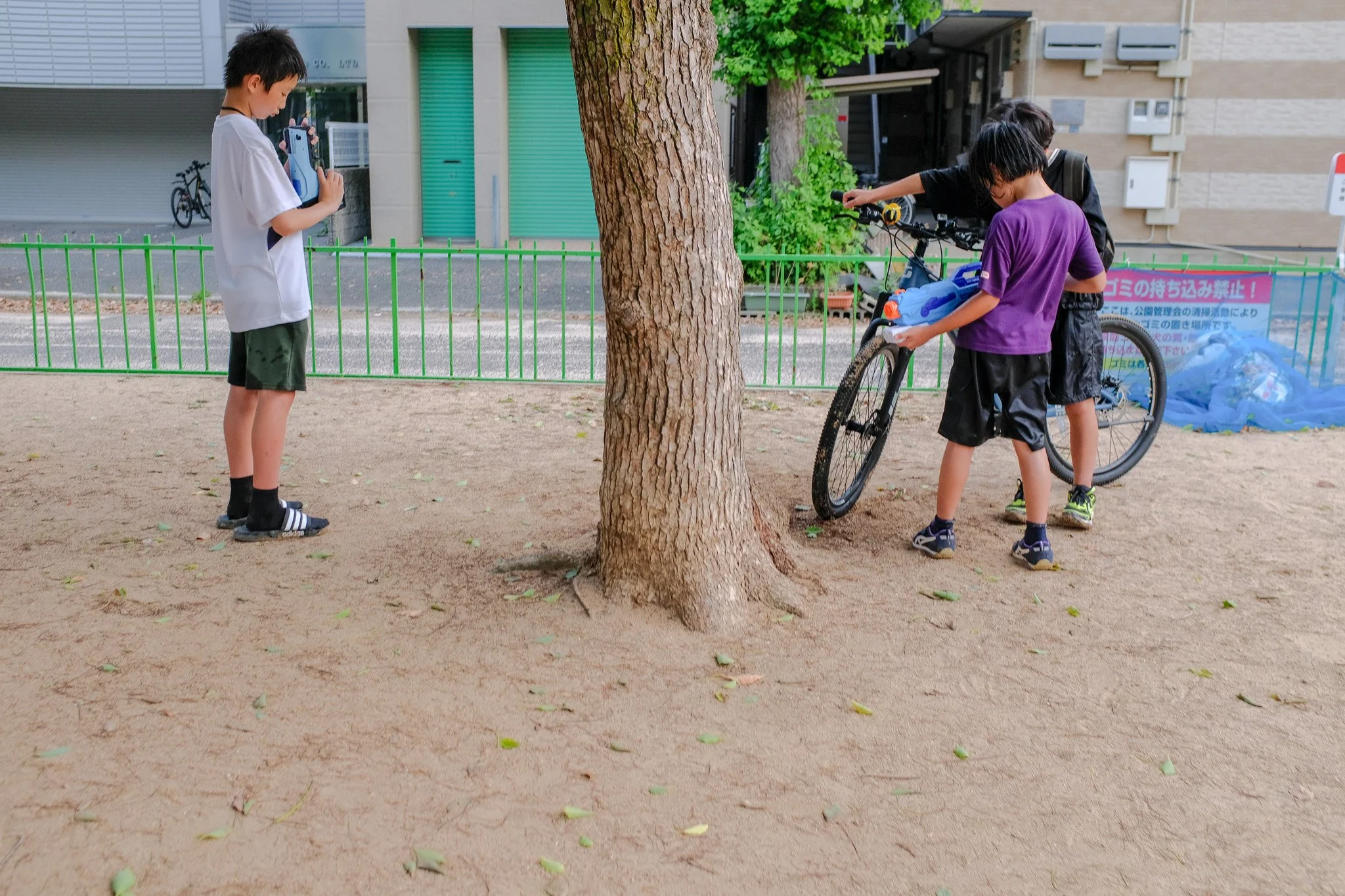
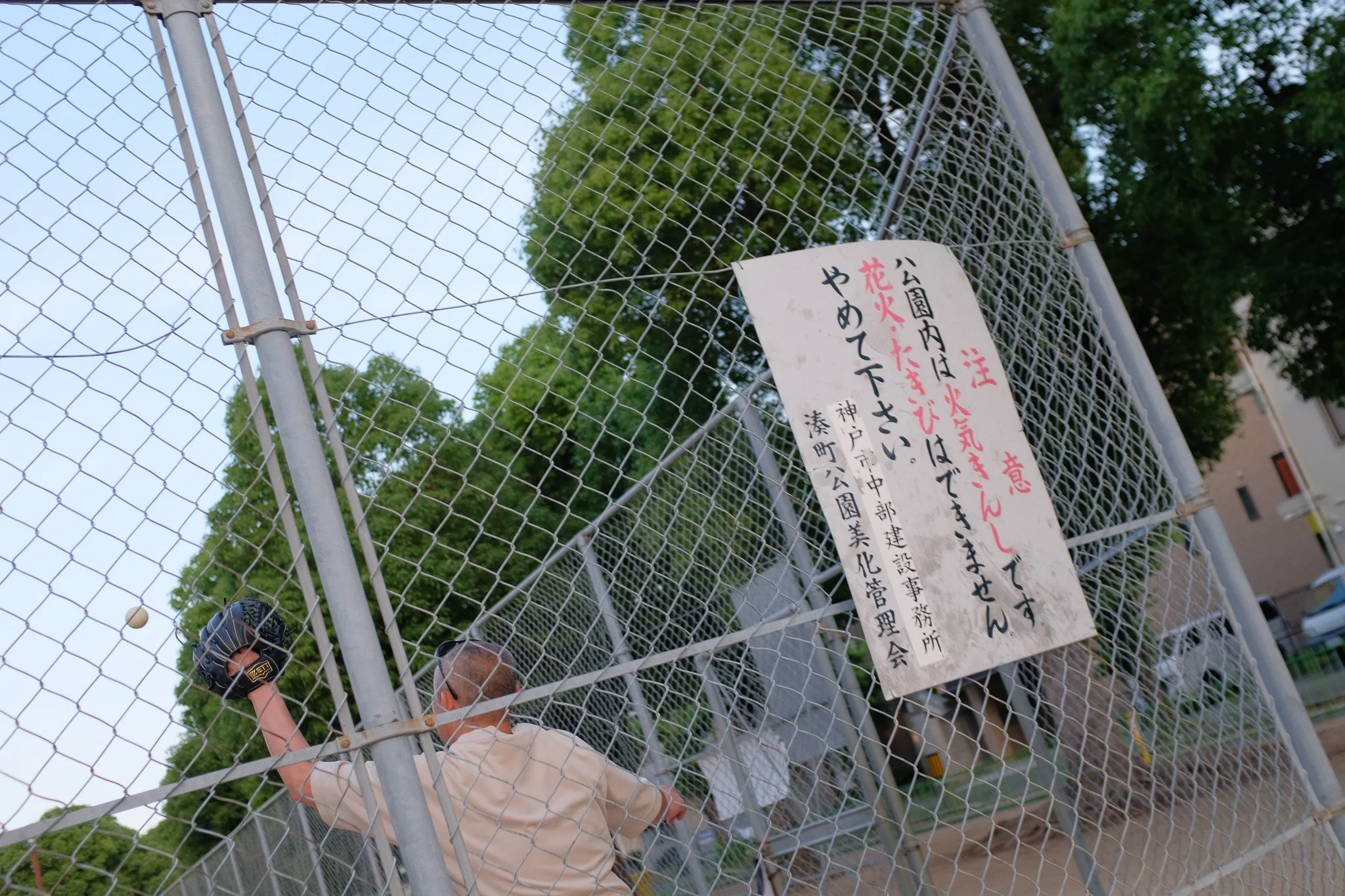
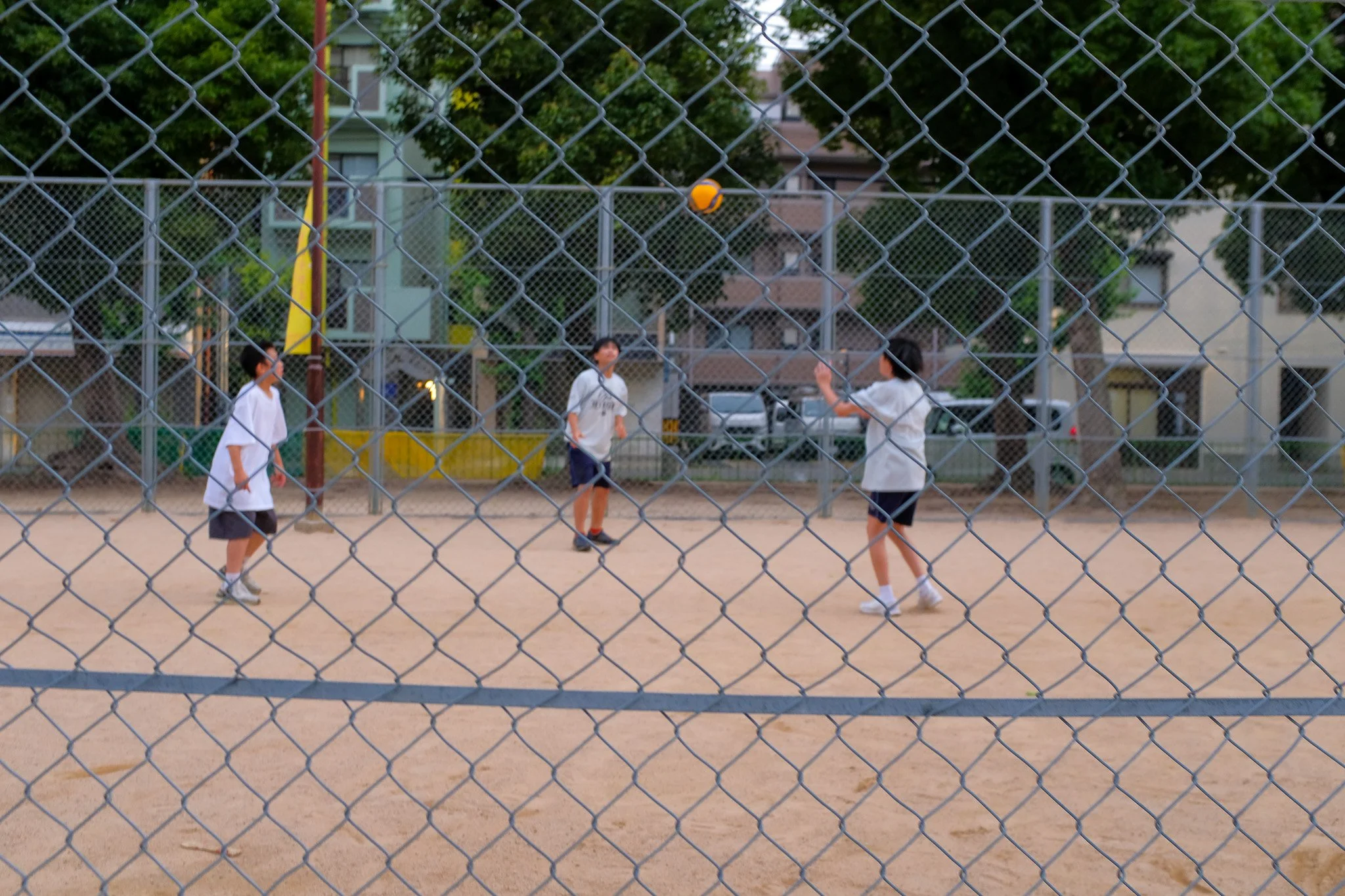
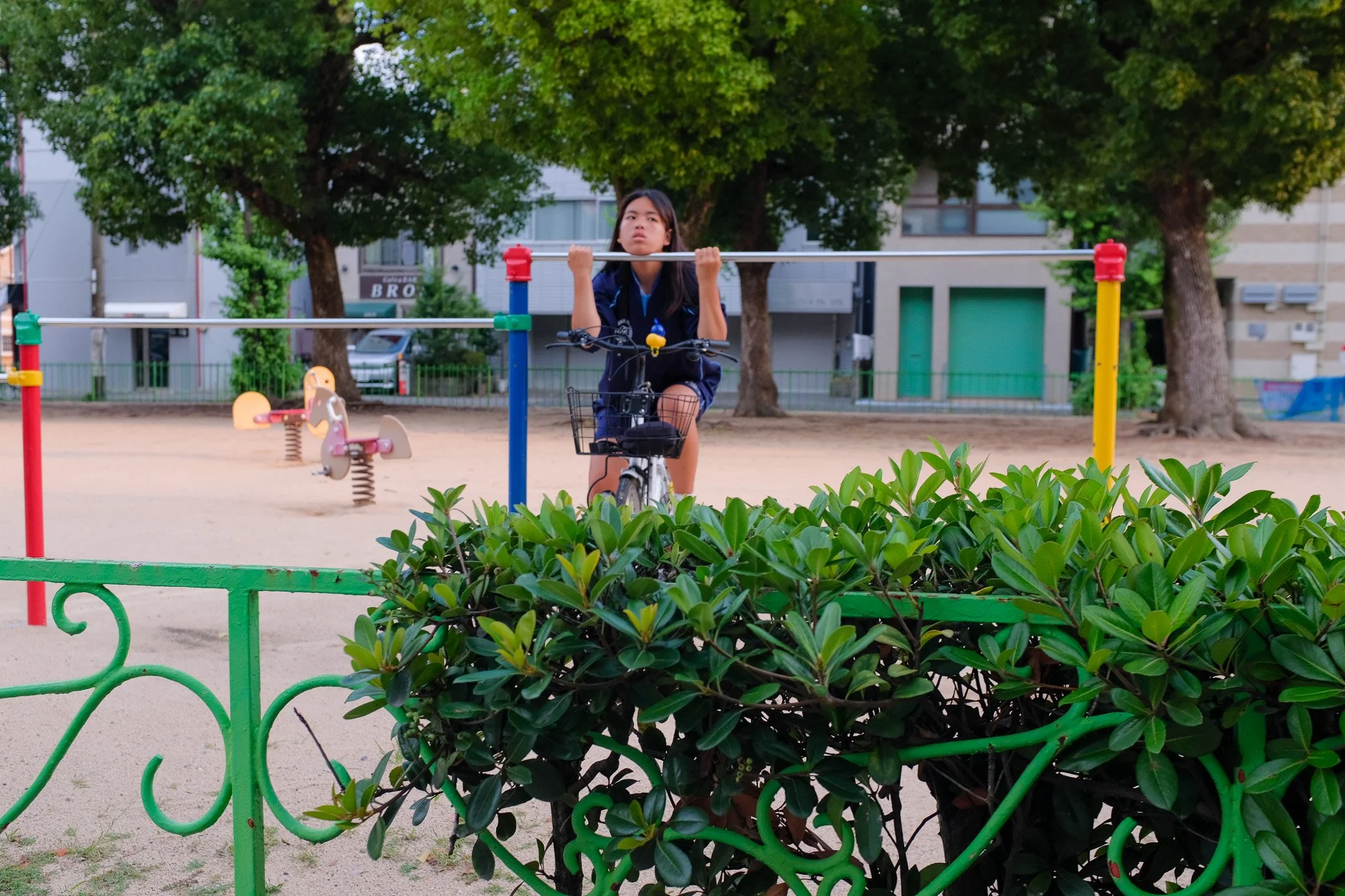
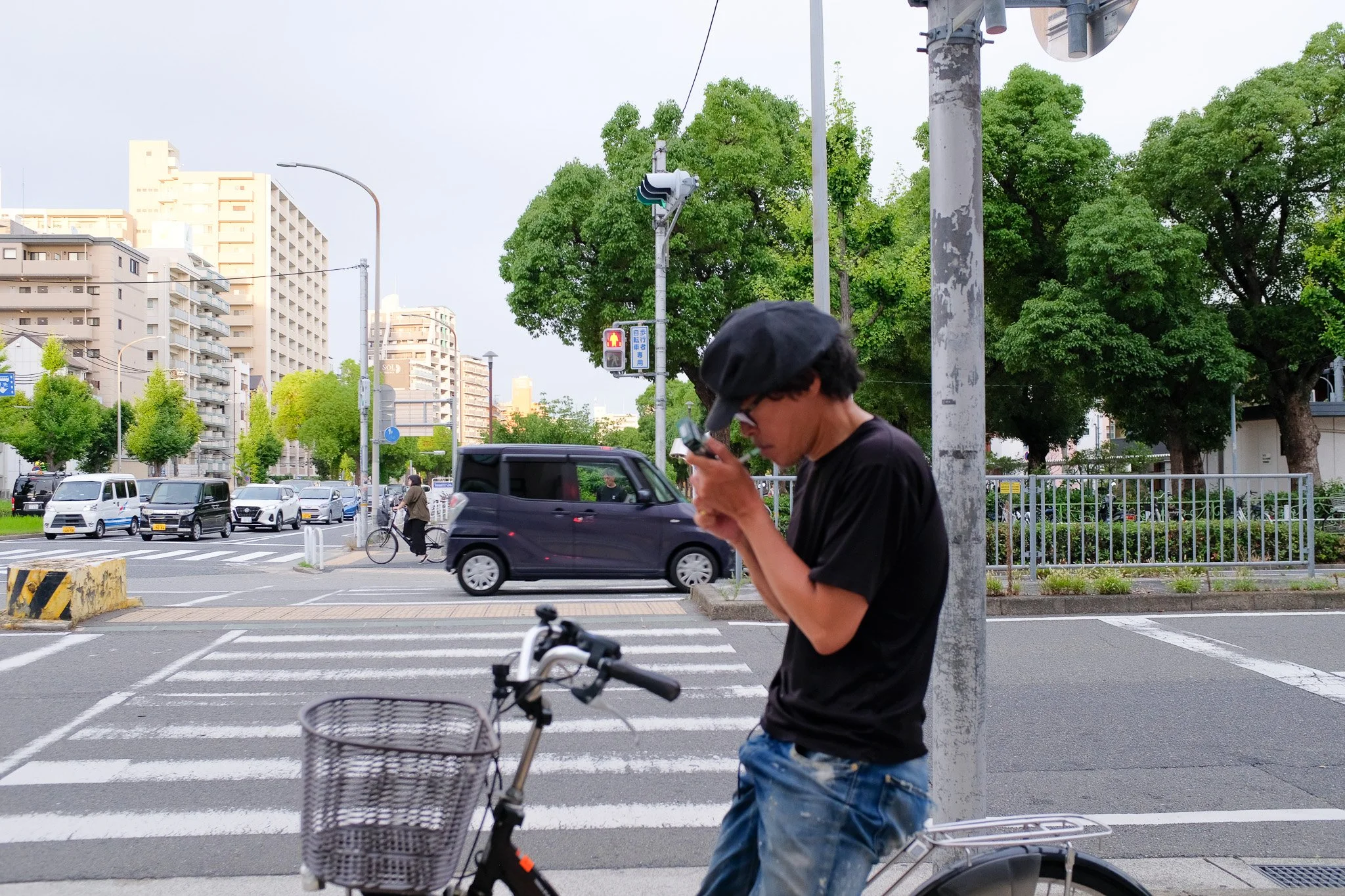
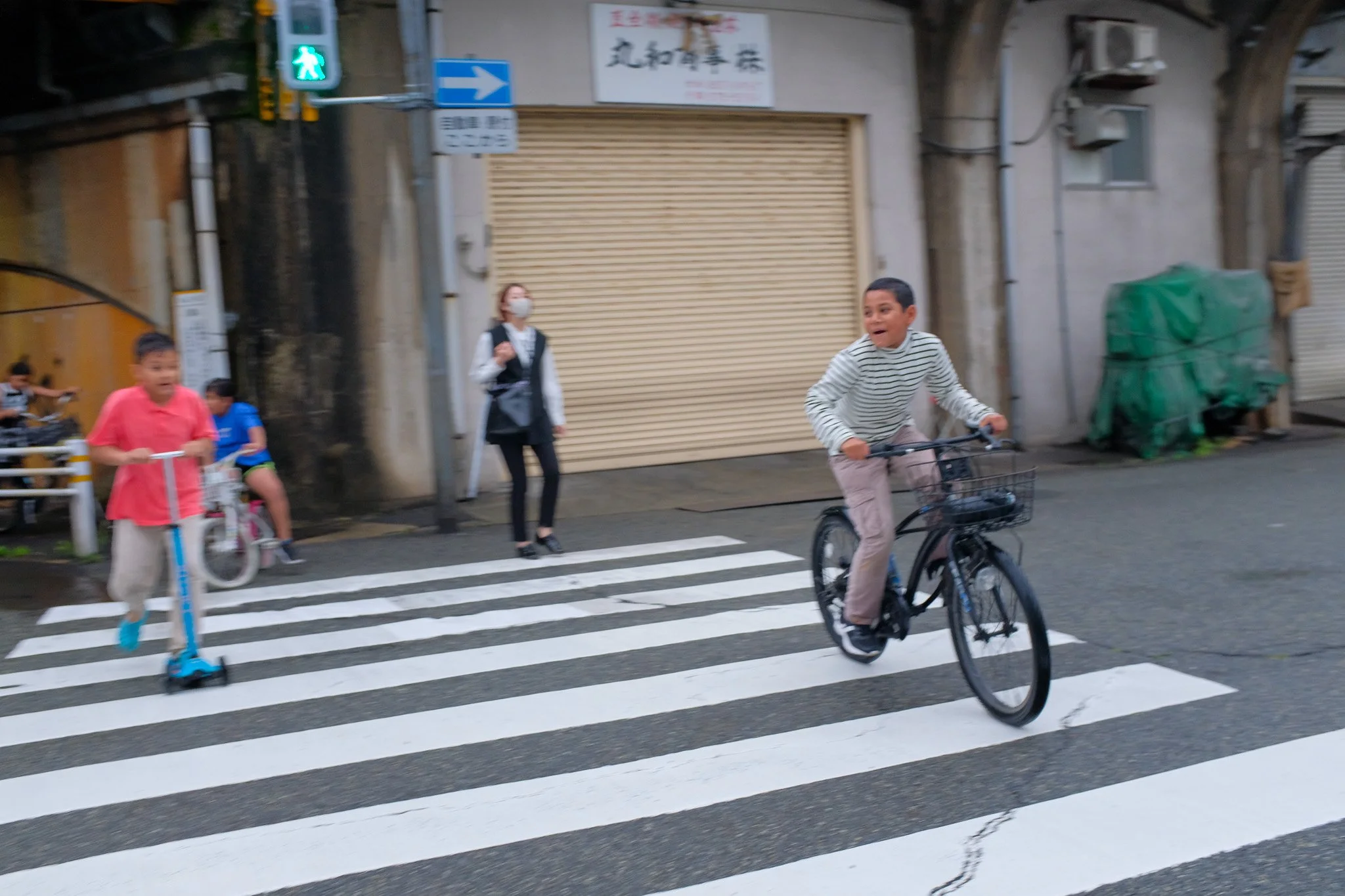
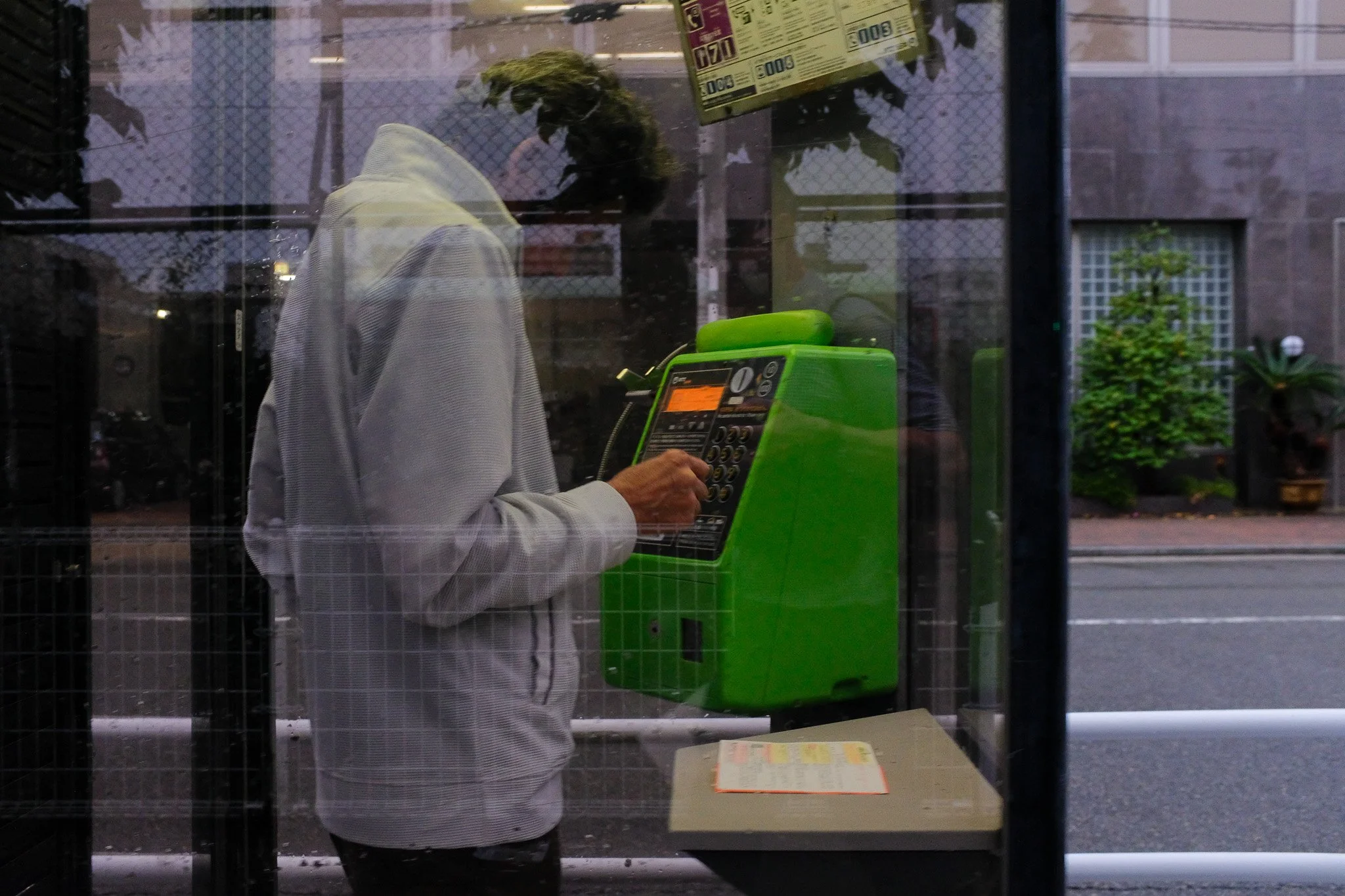
Despite how tired I may be after a day of teaching, I still maintain the practice of taking a handful of shots every evening on my walk home from the station. I usually follow the same route, passing the local bike shop, park, bank and supermarket. The Hankyu Line recently changed its timetable and I will occasionally alight one stop earlier for an extra 15 minutes or so of attempting to capture life. I often come home empty handed. The light can be challenging to work with at this time of day and my mind can be exhausted from engaging inside the classroom all day. Thus, neither my thoughts nor my photography are at their proverbial sharpest.
However, I find some sort of magic with each click, click, click of the shutter which keeps me optimistic and persistent in this practice. And just sometimes I will snag something that I think will be worth looking back on. It is my hope and goal to continue this practice until I can no longer press the shutter or the simple act of stopping time in rectangular fashion no longer thrills me. I recently read somewhere that it is probably better to write your goals down and share them with someone. Here we go.




He Only Sings When He’s Sad
Was I disappointed he didn’t play the aforementioned song that led me to M. Ward fandom for all these years?
It must have been around the time my journalism instructor in undergrad was giving a brief lecture on the importance of not beginning your news article with “it” that I first came across M. Ward’s music. All 2:38 of “Vincent O’ Brien” grabbed my entire conscience and I was immediately drawn into the warmth of not only Ward’s voice, but the entirety of his production, a sound not unlike many others, but one all his own. A challenging task for any artist: Draw from your influences while spinning your own spin.
Since that first introduction to M. Ward’s catalogue in the early 2000s, I have continued to enjoy his music. I was lucky enough to see him open for Bright Eyes on their Lifted tour in 2002. In 2004, I saw him perform with Conor Oberst and Jim James on their “Monsters of Folk” tour (the three later formed Monsters of Folk and released a pretty great record in 2009). Other memories of M. Ward’s music includes hearing one or two of his tracks from Post-War at my good friend’s wedding reception in 2007 and recently rediscovering his 2009 release Hold Time thanks to the abundant used CD market in Japan. In short, M. Ward has been a memorable part of my musical conscience for the better part of two decades.
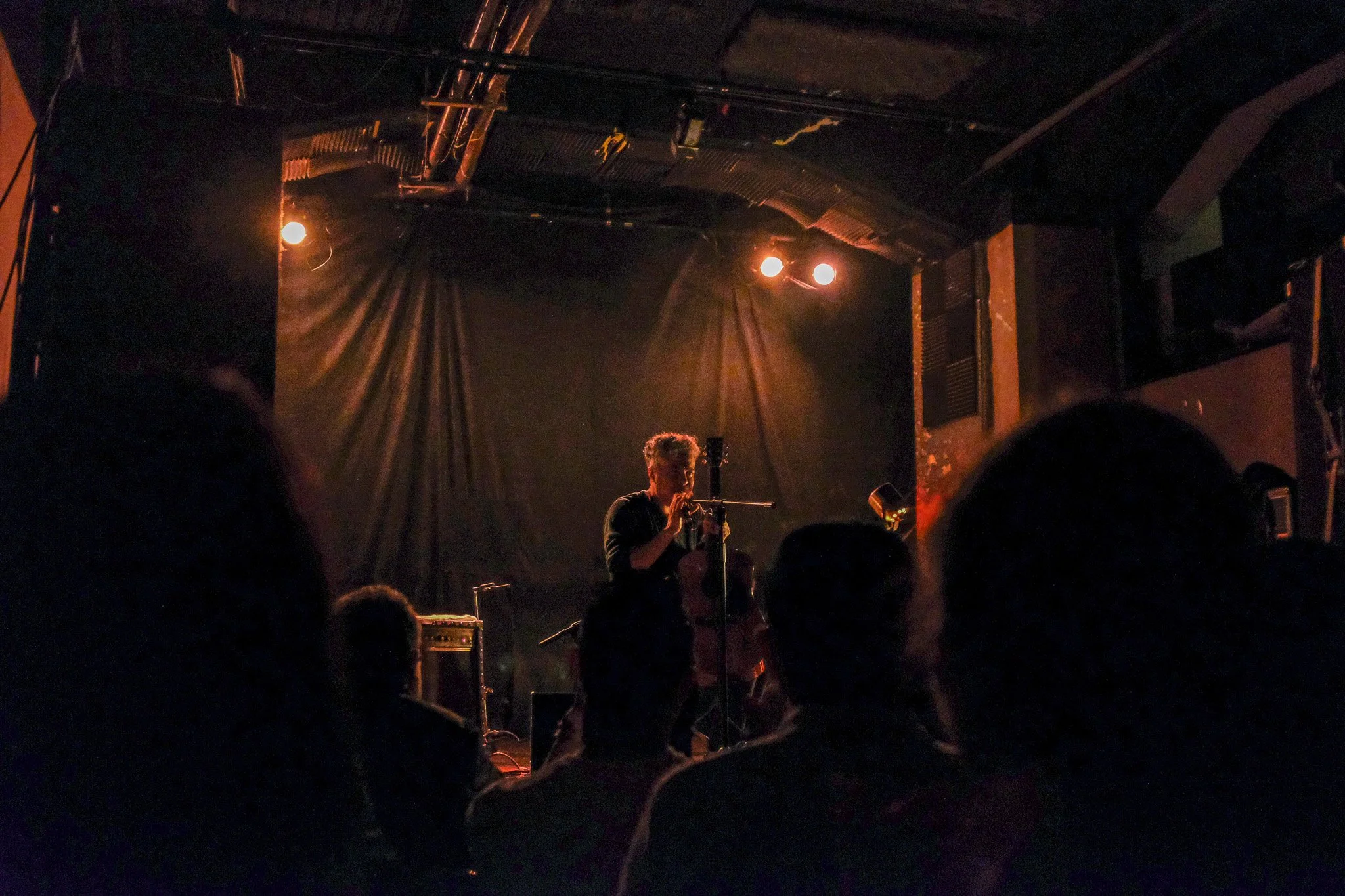
M. Ward telling stories
When I found out he was touring Japan this spring in support of For Beginners: The Best of M. Ward, it was a no-brainer to secure tickets to his Noon+Cafe performance in Osaka. My wife Airi and I arrive at Noon+Cafe a bit early as we had a hunch we could snag a place to sit. Our prediction was correct and we found two seats stage-left/middle-back; roughly 10 metres from the cozily lit stage. Noon+Cafe is intimate, as perhaps the name suggests, and immediately upon entering it felt like the absolutely ideal place to see an artist such as M. Ward. It is dark with no frills, a faint smell of lingering tobacco from years gone by, and a small staircase stage-left, leading up to the green room where M. Ward awaited his entry to the 80 or so in attendance. Before M. Ward took the stage, a bottle of red wine with its cork patiently resting on top was placed on a table across from M. Ward’s patiently awaiting Martin. An announcement was made that taking video would be prohibited, but that it would be ok to take flash-free photographs. There would also only be one set and M. Ward would also be available to sign vinyl records and other items after the performance.

M. Ward exits stage left
With all housekeeping items out of the way, we were left to wait just a few more minutes before M. Ward emerged from the attic, grabbed his guitar and eased us into his world with two guitar-only songs, one of them being “Duet for Guitars #3” from Transfiguration of Vincent. Now, here is where I must refer to the importance and absolute beauty of M. Ward’s sound. As soon as the guitar reverberated from the amp and began to fill the room, we were transported into the M. Ward sound that he has so masterfully executed throughout his catalog. Some may call it warm, others may call it analog gold, or sepia-toned-Americana-folk-blues; an inimitable ambience. It is quite difficult to put into words what exact tones M. Ward assembles from his guitar and amplifier and perhaps even unnecessary, but rare it is to hear an artist perform a selection of songs from their catalog in the way M. Ward did at the Noon+Cafe. He not only masterfully represented the sound of his recorded work in the live setting, but also recreated it in a way that gave the songs this entire new life; a life only for those lucky enough in attendance to hear. Ward treated us to nearly 90 minutes of these recreations, which included gratitude filled stage banter, two encores and a multitude of live looping his guitar to magnetically fill the room.
Was I disappointed he didn’t play the aforementioned song that led me to M. Ward fandom for all these years? Well, maybe a tad, but in the end I was won over just as much as hearing his music for the very first time.
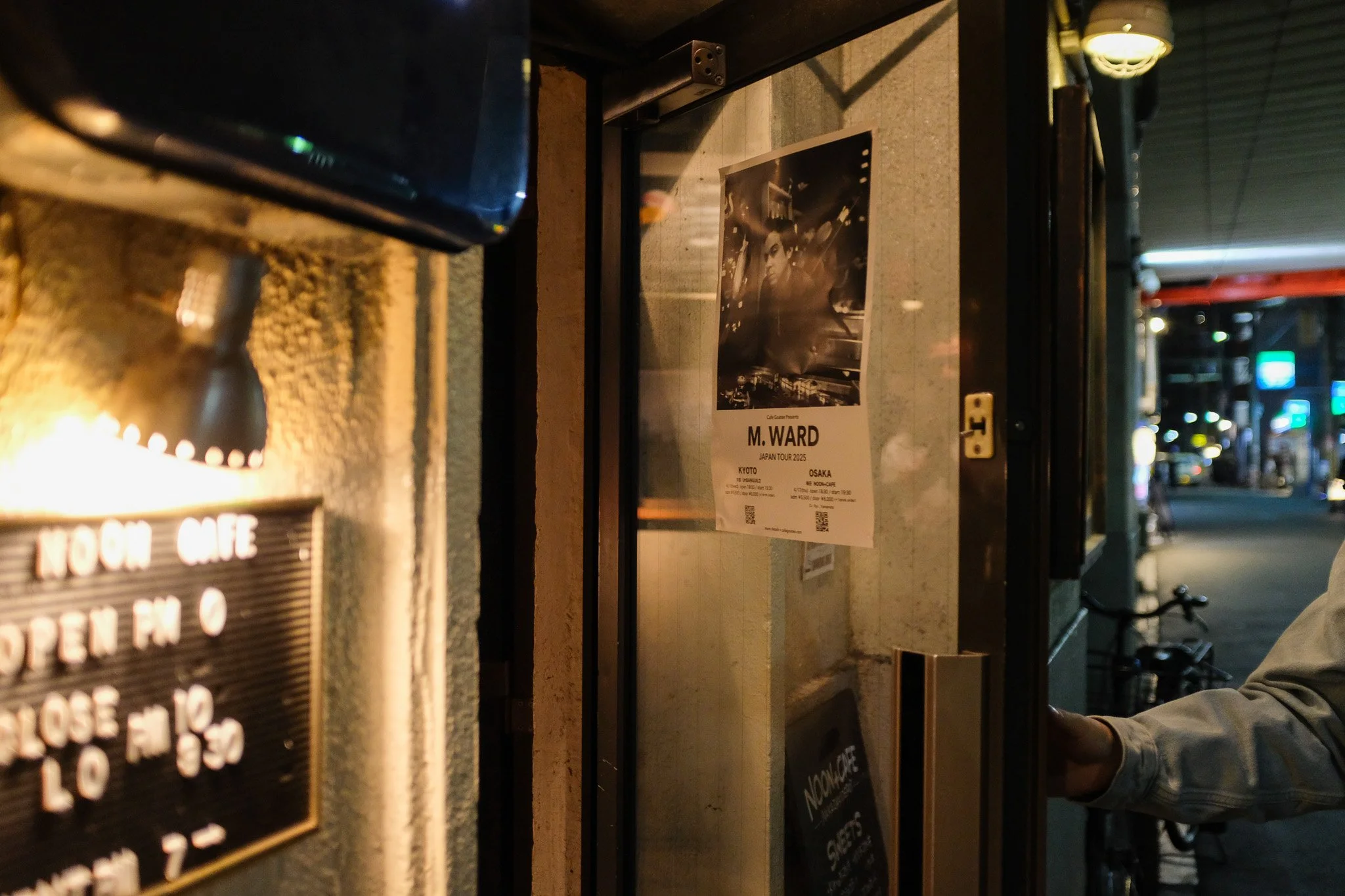
Promotional poster on cafe door

I Already Know What the Next Song Will Be
Is hearing a legendary album played live sequentially an exciting and/or overall good experience?
WEEZER
Zepp Bayside Osaka
Tuesday, January 7, 2025
19:00-20:40
This past winter, I finally got a chance to see the celebrated rock band Weezer perform live. The concert began promptly at 7pm, like a movie in the theatre, but without the popcorn and dimly lit aisles. Their entire performance clocked it at around one hour and 40 minutes.
Before attending the show I did not check their previous show setlists. I prefer being surprised by what a live act will do on any given night. I knew that Weezer had recently wrapped up a tour in the United States which celebrated the 30th anniversary of their classic debut Blue Album. On the American tour, the band played said record in its entirety (and presumably in order). In Osaka, it was a mystery if this was on their agenda. The show began with a smattering of non-Blue Album radio hits, which included the likes of "Beverly Hills" (Make Believe - 2005), "Island in the Sun" and "Hash Pipe" (Green Album - 2001) and even the college-radio-hit “You Gave Your Love To Me Softly” (Angus Soundtrack - 1995). Weezer then launched into a series of songs from their much-loved, but not at the time critically-adored, but now heavily-lauded, sophomore album, Pinkerton. They played "Across the Sea", "Getchoo" "Pink Triangle" and one or two others. Still no sign of the Blue Album. Enter a short intermission and a clothing change. After an announcement from frontman Rivers Cuomo that they were about to enter the Blue Universe it was apparent what the next 40 minutes would entail: The Blue Album played front to back, sequentially and with very minimal (if any) stage banter in between.
And this brings me to my key observation and question: Is hearing a legendary album played live sequentially an exciting and/or overall good experience? Subjective of course, but aren’t most essays? I argue that while it was most excellent to hear every song on The Blue Album performed live, knowing that they were playing it in order and without much interruption or anticipation was surprisingly a little awkward and an oh-so-slight, well, almost, dare I say, letdown. That may be a harsh critique, I understand. Clearly a lot of these album anniversary tours are geared to do just that: Rehash a memory of 20 plus years ago, tantalizing our collective amygdala, as we sing-a-long in an irreversible bliss of nostalgia. However, there is zero element of surprise when an artist/band/musician plays an entire album in its entirety in its recorded order. No one leaves the concert saying to their friends, “I cannot believe they played the near-eight-minute closing song ‘Only in Dreams’”! It took a bit of the mystery and wonder away from what a live show has the potential to be, and nearly made it feel like watching a movie for the third time. Still entertaining, but you know exactly what is going to happen.

Before the Phones Told Us Where to Go
So what exactly was life like before following the blue dot on Google Maps?
“Before the phones told us where to go” - a line from John K. Samson’s “Oldest Oak at Brookside” (Winter Wheat, 2016) is a line I often ponder while roaming countless city blocks attempting to stop time in rectangular fashion. As the line repeats in my head while I snap the shutter release, I also ponder the following questions: Is life better now that we are constantly connected and no longer have to Magellan our way around the world? What role, if any, does photography play in navigation? I attempt to answer these questions and more in this short-ish essay.
So what exactly was life like before following the blue dot on Google Maps? Well, maybe it was not that much different. Perhaps the better question is what was navigation like before the internet? Or before maps even? Just how did the Polynesians discover the Hawaiian islands anyway? Luck? The stars? A bit of both? I do not have the resources to answer those questions at the moment, so will stick to a brief story of the Hostel Treasure Map, a term coined in the Fall of 2009 while backpacking around Japan and Korea.
I was in Kyoto in the autumn of 2009, solo traveling with a North Face slingshot backpack that fit everything including a mini-laptop (barely; bursting at the seams, but it worked). I had a hostel booked, was wide-eyed, and thrilled to be back in Japan after a five day mini-adventure in Korea. On the bullet train from Hiroshima, I glanced at my printed out directions and they read something along the lines of:
“Take the north exit from JR Kyoto Station and hop on the No. 12 bus. Ride that bus for roughly 20 minutes in a counter-clockwise direction. After about 20 minutes, get off the bus and walk north for 10 minutes. The hostel will be on your left.”
Huh!? All the best finding that hostel. I ended up not following those directions as I arrived at Kyoto station later than expected. The hostel’s website stated that you could not check in past 8pm, which at the time made absolutely no sense. I did not have access to the internet on the fly to confirm such potential rumours. Thus, I hopped in a taxi and with my completely elementary Japanese somehow communicated to the driver to take me to said hostel. Point being: somehow I survived and relied on other navigation/survival skills to traverse around the globe before the phones told us where to go. And perhaps it was all a little more adventurous.
In pre-smartphone era Japan, I would take photographs of key intersections on my deck-of-card-sized point-and-shoot so I could retrace my steps back to the hostel. This often worked quite well and also gave me some decent photographs to sift through at the end of the travels. But, not now! What are we doing now to navigate unchartered territory? Of course, you know the answer. Our phones are telling us where to go, which is all well and fine, incredibly convenient, and comforting, especially in places where we may not speak the language. Additionally, I have been able to get to many places with minimal effort because of this 5g-connected rectangle in my pocket. So much now that I rarely think twice before leaving the house of how to get to where I am going. A safety blanket for the ages.
So is life better now that we are constantly connected? A brief saunter around Shinsaibashi and Amemura in Osaka recently had me thinking perhaps not always. I could not help but notice many tourists with a phone in hand, likely following the blue dot from destination to destination. And this is nothing new, but it got me thinking that it may be kind of fun to leave the house again someday without the connectivity and just simply go with the flow.